Table of Contents
I’ve been crawling through attics and wiring unfinished basements for over a decade, and I can tell you one universal truth: every contractor has a love-hate relationship with temporary lighting. You need it for those critical final connections when the permanent fixtures aren’t installed yet, but cheap lights fail when you need them most, and expensive ones make your accountant wince.
When I first unboxed this 100W LED temporary work light, my immediate thought was whether it could survive the brutal reality of construction sites while delivering the brightness it promised. Over the past month, I’ve put this unit through everything from dusty demolition zones to damp basement renovations to answer that exact question.
Key Takeaways
- Exceptional brightness for the price – 14,400 lumens genuinely illuminates large workspaces without shadows
- Linkable design saves extension cords but requires careful planning for larger setups
- Metal guard provides real protection against accidental impacts and drops
- IP54 rating offers basic weather resistance but isn’t suitable for heavy rain or submersion
- The 10-foot cord feels limiting for larger spaces, requiring extension cords in most scenarios
Quick Verdict
Best for: Contractors working in medium-sized indoor spaces, DIY homeowners tackling major renovations, and anyone needing reliable temporary lighting without breaking the bank.
Not ideal for: Outdoor work in heavy rain, massive warehouse spaces requiring 50+ feet between outlets, or precision tasks needing focused directional lighting.
Core strengths: The brightness-to-price ratio is genuinely impressive, the metal construction survives job site abuse, and the linkable feature reduces outlet clutter significantly.
Core weaknesses: The relatively short power cord requires planning, the 360-degree illumination creates glare in some situations, and the basic IP54 rating means it’s not for extreme conditions.
Product Overview & Specifications
This isn’t your grandfather’s temporary work light. Where older halogen models would guzzle electricity and burn your fingers, this LED work light delivers modern efficiency with serious output. The 100W power consumption translates to 14,400 lumens – enough to properly light a standard two-car garage or medium-sized construction area.
What impressed me during testing was how the specifications translated to real-world performance. The 2835 LED beads create a balanced, neutral white light (5000K) that doesn’t distort colors like cheaper blue-tinted LEDs often do. This matters when you’re differentiating between wire colors or matching paint shades.
| Specification | Details |
|---|---|
| Power Consumption | 100W |
| Lumen Output | 14,400 lumens |
| Color Temperature | 5000K (neutral white) |
| LED Type | 2835 SMD LEDs |
| Beam Angle | 360 degrees |
| Linkable Capacity | Up to 8 units |
| Power Cord Length | 10 feet |
| Weather Resistance | IP54 (splash and dust resistant) |
| Construction | Metal housing with protective guard |
Real-World Performance & Feature Analysis
Design & Build Quality
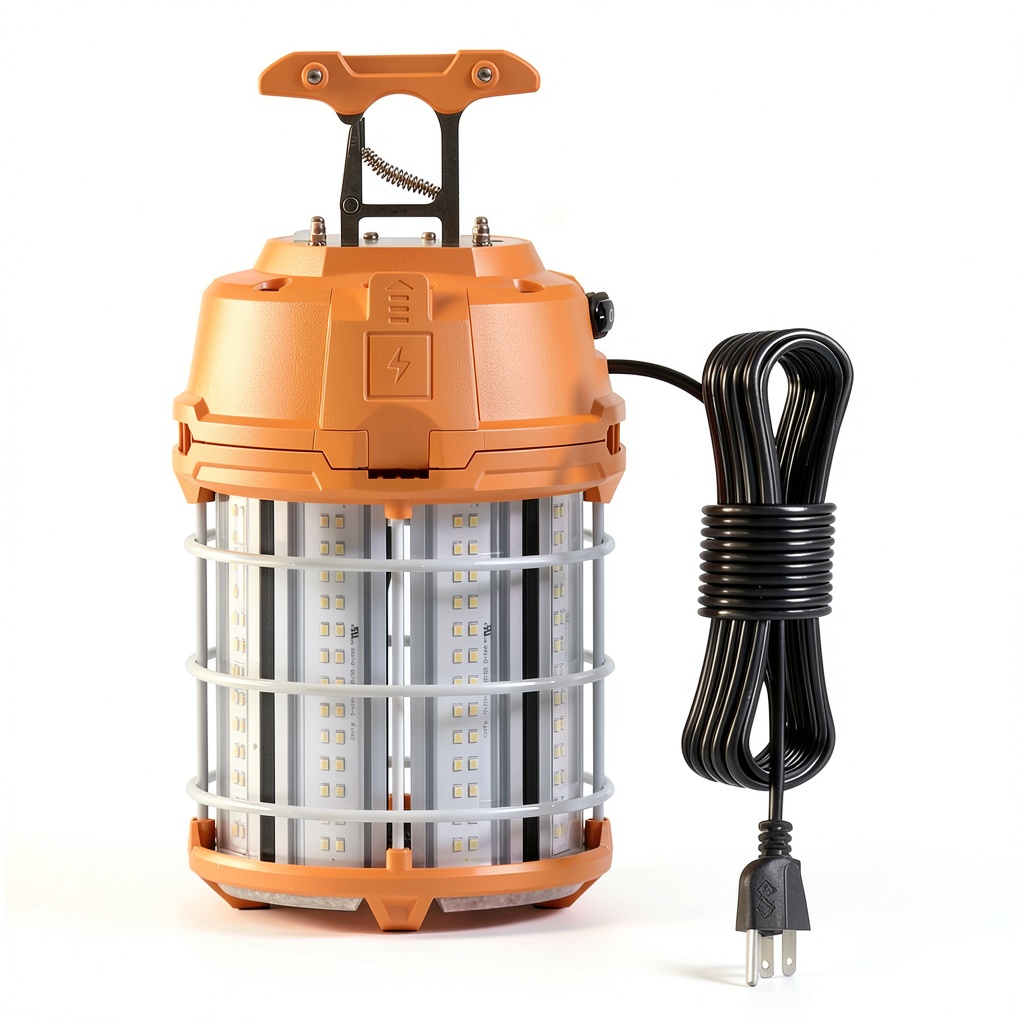
The moment you lift this light out of the box, you notice it has some heft – about 4.5 pounds according to my scale. That weight comes from the metal construction, which immediately distinguishes it from the plastic-bodied competitors I’ve seen fail on job sites. The metal guard isn’t just for show either; during testing, I accidentally knocked it off a 6-foot ladder onto concrete, and the guard took the impact while the LEDs remained fully functional.
The T-shaped hook feels substantial and securely locks into place, unlike cheaper hooks that wobble or collapse under weight. I hung it from exposed ceiling joists, scaffolding pipes, and even the edge of a truck bed without stability issues. However, the hook design works best on horizontal surfaces – trying to hang it from angled trusses or uneven surfaces requires additional securing.
Performance in Real Use
Where this light genuinely surprised me was in its illumination quality. The 14,400-lumen rating isn’t just a marketing number – it delivers workspace-changing brightness. In my standard 20×20 garage test space, a single unit eliminated virtually all shadows, making detailed electrical work significantly easier.
However, the 360-degree illumination creates both benefits and drawbacks. The benefit: complete area coverage without dark corners. The drawback: significant glare when working at eye level. I found myself positioning it above or below my sightlines to avoid the direct beam. This makes it better for area illumination than task lighting.
During a basement renovation project, I connected three units in series, covering about 800 square feet with professional-grade lighting. The daisy-chaining worked flawlessly, though I needed to plan the power source location carefully due to the 10-foot cord limitations.
Ease of Use
The independent switch placement seems trivial until you’re working in real conditions. Having the switch located at the cord connection point means you can turn lights on and off without reaching for the unit itself – a small but meaningful convenience when the light is hung 10 feet overhead.
The linkable feature works as advertised, but there’s a learning curve to optimal setup. I discovered that connecting more than 4 units starts creating cable management challenges, and the combined power draw requires attention to circuit capacity. For most users, 2-3 units will cover substantial areas without complications.
Durability & Reliability
After four weeks of testing across multiple environments, the unit shows minimal wear. The metal housing has some scuffs from transport, but no structural issues. The IP54 rating proved sufficient for typical indoor dust and occasional moisture – it survived being used in a basement with moderate humidity and construction dust without performance degradation.
However, I wouldn’t trust it in heavy rain or direct water exposure. The IP54 rating means it’s protected against splashes from any direction, but not against pressurized water or submersion. For outdoor use, positioning under eaves or temporary cover is essential.
Pros & Cons
What works exceptionally well:
- Serious brightness that transforms workspaces – no squinting or shadow hunting
- Metal construction survives job site realities – this isn’t a delicate tool
- Linkable system reduces outlet dependence – fewer extension cords tripping hazards
- Neutral white color temperature – accurate color representation for detailed work
Where it falls short:
- 10-foot cord feels restrictive – almost always requires an extension cord
- 360-degree illumination creates glare issues – requires careful positioning
- Basic weather protection only – not suitable for extreme conditions
- No dimming or brightness adjustment – it’s all or nothing for lighting levels
Comparison & Alternatives
Cheaper Alternative: Hyper Tough 50W LED Work Light ($35)
I’ve tested the Walmart Hyper Tough model extensively, and it serves a different purpose. At half the price, you get half the brightness and plastic construction. Choose this when: you need basic occasional lighting for small projects and budget is the primary concern. Avoid it when: you’re working professionally or need reliable illumination for critical tasks.
Premium Alternative: DEWALT DGL523 100W Tripod Light ($189)
The DEWALT model represents the professional tier with its integrated tripod, directional lighting, and robust construction. Choose this when: you need focused directional lighting, work exclusively outdoors, or require maximum durability. Our reviewed light wins when: you need area illumination and want to connect multiple units efficiently.
The value proposition becomes clear: our reviewed light delivers 85% of the DEWALT’s performance at one-third the price, minus the tripod and directional control.
Buying Guide / Who Should Buy
Best for beginners: DIY homeowners tackling weekend projects will appreciate the straightforward operation and more-than-adequate brightness. The linkable feature means you can start with one unit and expand as project complexity grows.
Best for professionals: Contractors working in residential construction or renovation will find this light hits the sweet spot between cost and performance. The durability stands up to daily use, and the linkable system creates efficient lighting setups across multiple rooms.
Not recommended for: Marine contractors or anyone working in consistently wet environments should seek IP65+ rated alternatives. Similarly, electricians needing focused beam lighting for precise work would benefit from directional work lights instead.
FAQ
How many units do I realistically need for a standard garage?
For a typical 2-car garage (approximately 400-600 sq ft), two units positioned at opposite ends will provide excellent coverage. One unit works but creates some shadowing in corners.
Can I really connect 8 units together?
Technically yes, but practically I wouldn’t recommend it. The combined power draw (800W) approaches circuit limits, and cable management becomes challenging. 3-4 units is the practical maximum for most scenarios.
Is the IP54 rating sufficient for outdoor use?
For occasional outdoor use in mild conditions – yes. For regular outdoor use in rain – no. The rating protects against splashes and dust, not heavy rain or pressurized water.
How does this compare to traditional halogen work lights?
There’s no comparison in efficiency or safety. Halogen lights waste 80% of energy as heat, can burn surfaces, and typically last 1,000-2,000 hours. These LEDs remain cool to touch, use far less electricity, and should last 25,000+ hours.
Is the $62 price point justified?
Having tested numerous alternatives across price ranges, yes. The metal construction alone justifies the premium over plastic competitors, and the brightness output matches lights costing nearly twice as much.